
Professor Guojun He and Ms Qidan Wang
8 July 2026
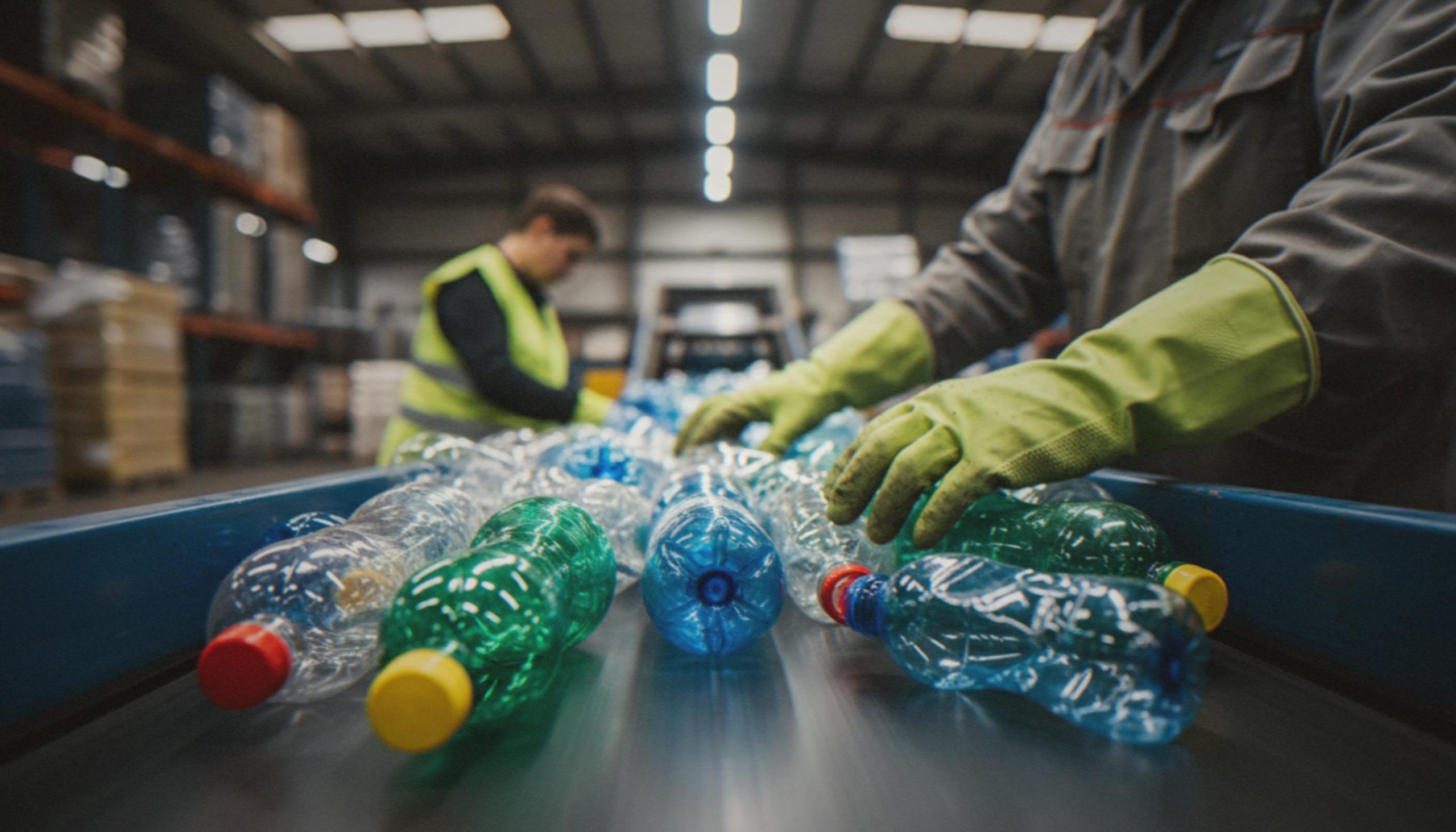
After pouring away the remaining half bottle of distilled water, you put the plastic bottle, with its cap and label still attached, into the brown bin on the street corner. As far as you are concerned, that is the end of the bottle’s story. However, there is a good chance that the bottle will not make its way to recycling, but will instead be sent to a landfill.
Plastic reduction works, but recycling lags behind
The story begins with two sets of figures from 2024. On the one hand, the disposal of waste plastics in Hong Kong declined from 2,120 tonnes per day in 2023 to 1,885 tonnes per day, representing a decrease of 11.1% (see Note 1). Under the Product Eco-responsibility (Amendment) Ordinance 2023, the first phase of regulation of disposable plastic products was implemented in 2024. Coupled with other plastic-reduction measures, such as enhancements to the Plastic Shopping Bag Charging Scheme, these initiatives are beginning to take effect. On the other hand, the quantity of plastics recycled over the same period dropped sharply from 128,200 tonnes to 101,500 tonnes, representing a decrease of more than 20%, roughly equivalent to the weight of 1,800 double-decker buses.
Less plastic is being discarded at source, yet the amount recovered for recycling has declined even more. If progress has been made in plastic reduction, why has recycling fallen behind?
Tracing the roots of the recycling bottleneck
Let us examine the three stages of the recycling chain, one by one.
First, exports. In explaining the decline in plastics recycled, the Environmental Protection Department cited the backdrop of tighter global import controls under the amendments to the Basel Convention. However, plastics recycling in Hong Kong has barely relied on exports in recent years. Research by the Legislative Council indicates that “almost all recovered plastics in Hong Kong are processed locally” (see Note 2). In 2024, exports of plastics amounted to only about 10,000 tonnes (see Note 3), far too little to explain the decrease of 26,700 tonnes.
Second, local processing. At present, Hong Kong’s only near-food-grade plastic bottle recycling facility can convert waste plastics into recycled polyethylene terephthalate (rPET). Its maximum monthly capacity of about 1,200 tonnes is theoretically sufficient to handle around half of all plastic beverage containers sold locally. However, since commencing operation in 2022, the facility has suffered from insufficient intake; in 2025, it was operating at only about 40% of its capacity. This shows that the bottleneck lies not in processing capacity, but in the actual amount recovered.
Having ruled out these two factors, the decline clearly lies at the front end of the chain. Plastic bottles are either not placed in recycling bins by members of the public in the first place, or, after being deposited, are treated as rubbish because they are heavily contaminated. The former concerns “quantity”, while the latter concerns “quality”. Both point to the same problem―how the public handles waste plastic containers and how producers design their products.
Who should be responsible for the clean-up
In the late 1990s, the government introduced colour-coded recycling bins (blue, yellow, and brown), helping the public develop the concept of waste classification. Unfortunately, the issue of contamination was never properly addressed. Once plastic bottles are mixed with food waste, tissues, or residual liquid, the purity of the feedstock falls, and the costs of each subsequent processing step rise accordingly. If an entire bin of materials is too heavily contaminated, frontline contractors, after weighing costs and benefits, can only treat it as waste. This is one reason for the underutilization of local recycling and reprocessing facilities―even when waste plastic containers are collected, they often fail to meet near-food-grade standards because of contamination.
Product design is another key factor. Whether a plastic bottle can be “reborn” is, to a large extent, already determined at the moment it is manufactured. Clear, colourless PET is ideal. Coloured bottles, polyvinyl chloride (PVC) labels, and full-wrap labels all substantially reduce recycling value. Japan has long relied on industry self-regulation to make clear, colourless PET the mainstream material for plastic bottles. The Plastic Resource Circulation Act, implemented in 2022, further incorporated the plastic life cycle into integrated management. Members of the public also proactively remove labels and caps before recycling, resulting in exceptionally high feedstock purity for back-end processing.
By contrast, Hong Kong lacks both regulation and industry standards. Plastic bottle manufacturers focus more on shelf appeal and bear no financial responsibility for the after-use management of their products. With bottles produced in a variety of colours and labels designed in different forms, many are destined to be nonrecyclable from the outset. In practice, this amounts to shifting costs from producers onto society as a whole and the downstream recycling system.
Sending price signals to both supply and demand sides
Clearly, price signals are missing at both ends. Producers do not take recycling costs into account when designing packaging. When people discard plastic bottles, whether the containers are clean and whether they are returned to a recycling point have no effect on their own wallets. To realign dispersed individual decisions with environmental objectives, price signals should be provided on both the supply and demand sides.
Two tools are available on the supply side. First, fees under the Producer Responsibility Scheme could be tiered: higher fees should be charged for designs that are difficult to recycle, while fee reductions or exemptions should be granted for clear, colourless, single-material designs with easy-to-remove labels. References can be made to the practices of “recyclability ratings” under the European Union’s Packaging and Packaging Waste Regulation 2025/40 and the UK’s Plastic Packaging Tax. Second, a deposit-refund system could be introduced at the consumption level, putting a price on whether bottles are returned, so that returning plastic bottles becomes not merely an environmental good deed, but also an economic incentive. Germany’s deposit system, under which a deposit of 0.25 euros (approximately HK$2) is charged on certain plastic beverage bottles, has been sufficient to raise the recycling rate of these bottles to over 90%. Hong Kong need not copy this model wholesale, but even starting with a deposit of HK$0.5 to HK$1 per bottle would probably be sufficient to change public recycling behaviour.
It should also be noted that if no one purchases rPET, local recycling facilities will still be underutilized. This is because rPET usually costs more than virgin PET, while the environmental externalities of the latter have yet to be priced. Demand-side requirements must therefore be strengthened by incorporating a “mandatory recycled-content escalation schedule” into the Producer Responsibility Scheme. For example, plastic beverage bottles sold in Hong Kong could be required to contain at least 15% locally recycled rPET from 2027, rising to 30% by 2030. The fact that some local beverage brands have already adopted bottles made from 100% locally recycled rPET proves that these targets are technically achievable. What is lacking is a mechanism to turn this choice from a voluntary action by a small number of brands into a standard requirement across the entire industry.
Taken together, these three tools would constitute a complete closed loop. Differentiated fees push costs back to the design stage, a deposit-refund system attaches costs and incentives to the point of return, and mandatory recycled content creates market demand for rPET. Once all three signals are in place, there will be strong enough incentives for producers to improve product design, for consumers to return plastic bottles in a clean condition, and for recyclers to obtain a reliable supply of clean materials for reprocessing and sale.
Conclusion: think twice before you throw away a plastic bottle
The decline in the quantity of plastics recycled in 2024 is not due to external export controls or insufficient local processing capacity. Rather, it reflects failures in both supply and quality at the front end of the recycling chain, as well as a back-end market that has yet to make room for recycled materials. As plastic reduction at source begins to take effect and local processing facilities long remain underused, this rupture in the middle of the chain is precisely the missing link that Hong Kong must address for its plastics closed loop to shift from quantity to quality. Differentiating fees according to recyclability, introducing a deposit-refund system, and mandating recycled-content standards can simultaneously send the price signals missing on both the supply and demand sides. However, whether these signals can reach all the way from public recycling bins to reprocessing lines will depend on whether the system is designed with sufficient precision.
Prior to the implementation of this system, everyone should take a few extra seconds emptying any remaining liquid, removing the bottle cap, and tearing off the label. This will not solve all the problems, but it is one link in this long recycling chain where every citizen can do their part. The real test of Hong Kong’s plastics closed loop begins with the choice made in these two seconds―and with whether the system can make these two seconds worth the effort.
Note 1: https://impact.hkubs.hku.hk/wp-content/uploads/2026/08/292079-msw2024_eng.pdf
Note 2: https://impact.hkubs.hku.hk/wp-content/uploads/2026/08/292079-ISSH10_2024_20240520_en.pdf
Note 3: https://impact.hkubs.hku.hk/wp-content/uploads/2026/08/292079-fc_25-26_eng.pdf
Acknowledgements
The authors would like to thank Ms 鄭倩薇 for providing industry information for this article.