

Professor Guojun He and Qidan Wang
4 March 2026
All around the world, waste separation and recycling have become part and parcel of urban governance. Over the past decade, the SAR Government has, through the “GREEN@COMMUNITY” programme and GREEN$ Incentive Scheme, established a community recycling network throughout the city to mobilize the public to integrate recycling into their daily lives.
GREEN$ will be fully digitalized on 1 April 2026, with access to more commercial rewards platforms. However, can this upgrade truly facilitate the transition of the recycling system from “weight-based points” to “value-based incentives”?
Structure unchanged despite improving data
While municipal solid waste charging remains to be fully implemented, the GREEN@COMMUNITY programme and its complementary GREEN$ Incentive Scheme play an important role in encouraging the public to develop recycling habits and in building community networks. Since the programme’s full implementation in 2018, 12 recycling stations, 82 recycling stores, and approximately 600 recycling spots have been set up throughout Hong Kong. Following the digital upgrade, members of the public can use the mobile app to manage their points and redeem rewards, while the Government and operating agencies can also collect more granular participation data, providing a basis for future policy refinement.
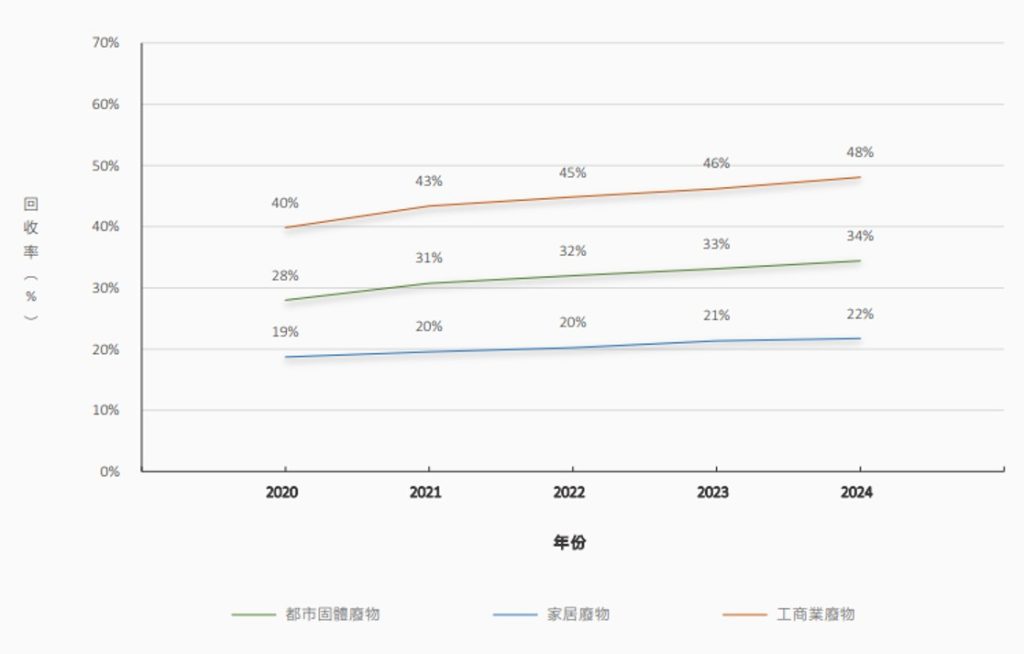
The resource recovery rate in Hong Kong has improved in recent years, with the overall recovery rate of municipal solid waste rebounding from approximately 28% in 2020 to 34% in 2024. However, this remains significantly below both the interim target of around 55% set out in the Waste Blueprint for Hong Kong 2035, as well as the EU’s average municipal waste recycling rate of approximately 48% in 2023 (see Note 1). Crucially, around 80% of recyclable materials in Hong Kong still rely on exports for recycling (see Note 2), highlighting inadequate support for the local recycling industry.
Figure 1 Recycling rates for municipal solid waste, domestic waste, and commercial and industrial waste in 2020–2024
Source: Environmental Protection Department
Misalignment between weight and value
Why is upgrading the point system not a once-and-for-all solution? We need to examine the economic logic behind recycling behaviour.
- The positive externalities of recycling have yet to be thoroughly internalized. Those taking the time to sort their waste and bring it to recycling spots can yield social benefits such as reducing pressure on landfills, conserving resources, and mitigating pollution. Yet the returns they actually get are limited and fragmented, without sustained incentive. By contrast, simply throw things away is far more convenient. Waning public enthusiasm for recycling can also be put down to repeated postponement of the waste charging scheme.
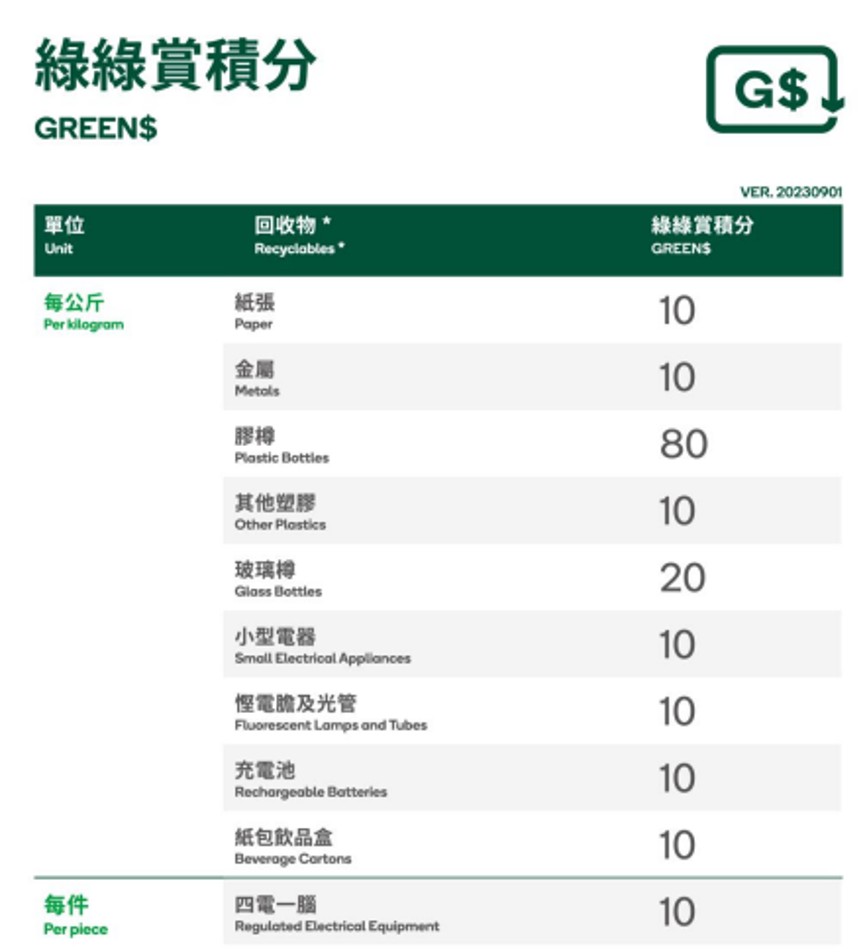
- The incentives inherently involve a twofold problem—a mismatch in value and a mismatch in form. The points scheme is based on weight (see Figure 2) rather than environmental value. The carbon-reduction and pollution-reduction benefits of recycling paper and metal vary enormously, and different electrical appliances likewise have different marginal environmental impacts. As the points rewarded are more or less the same, there is little incentive to motivate the public to prioritize recycling materials with higher environmental value. Moreover, the limited choice of rewards and opaque redemption process have also undermined the Scheme’s appeal.
Figure 2 GREEN$ Incentive Scheme
Source: Environmental Protection Department
- Information opacity has eroded public trust. While front-end sorting requirements are complex, back-end treatment process is like a “black box” to the public. There is no telling if items collected will be recycled, let alone where they ultimately end up. On the absence of tangible results, the time and effort people put in are easily seen as a “sunk cost”, which over time weakens their willingness to participate in the scheme.
Simply put, the points system does not effectively reflect environmental value, nor works in tandem with institutions, industry, and information transparency.
Enhancing recycling value through system design
In Japan, under extended producer responsibility, the Containers and Packaging Recycling Act explicitly requires packaging manufacturing companies and distributors to pay the costs associated with recycling. Along with strict source separation, Japan’s recycling rate for specified plastic bottles has long remained at a high level of approximately 85%, achieving a closed loop from product design to resource recovery.
The “four in one” model in Taiwan integrates the government, communities, recyclers, and funds. Upstream producers pay fees in accordance with regulations, while funds are used to subsidize downstream recycling and processing, mitigating reliance on long-term government subsidies.
Germany’s deposit-refund arrangements for plastic bottles and aluminium cans turn “whether to return the bottle” into a self-evident choice through a simple and direct economic signal. As a result, the recycling rate has consistently stayed high at around 90%. Coupled with the producer responsibility scheme, this has helped to drive the development of a high-quality closed-loop recycling-industry chain.
Taking these overseas experiences as a whole, recycling rates can be enhanced through various measures, making environmental value visible, measurable, and shared across all stages.
A holistic policy framework centred on data and value
The full digital upgrade of the GREEN$ Incentive Scheme will support Hong Kong in exploring “value-based incentives”, especially by driving transformation in the following four key areas.
First, a community-based, inclusive behavioural incentive programme should be launched, while the density of recycling collection spots is further increased and their daily operating hours extended. At source, through partnerships with schools, housing estates, and social welfare organizations, waste-sorting education should be normalized and integrated with practical recycling activities. During the digital transformation, consideration should also be given to providing assistance for the elderly and those unfamiliar with digital tools.
With the help of data from digital platforms, personalized waste reduction and carbon reduction reports can be pushed to the public while community rankings and achievement badges can be displayed. Such nudge tactics are conducive to turning points from a mere reward into ongoing feedback, thereby internalizing recycling as a daily habit.
Second, the points system should be redesigned around environmental value to guide recycling behaviour more precisely. Instead of simply relying on a weight-based points system, a differentiated points scheme based on environmental benefits should be established. One viable approach is to introduce an environmental benefit coefficient, taking into account factors such as the carbon footprint of materials, their local recycling value, and processing costs, and to assign different point values to different types of recyclables. This will enable materials with high carbon emissions and high reuse value (e.g. plastic bottles, metals, and specific electrical appliances) to receive more attractive point rewards. This approach will serve to not only guide the public to adjust their recycling priorities, but also quantify the ecological value of green behaviour for future integration with carbon-reduction accounting.
Third, building an open green points and responsibility mechanism linking consumption scenarios and the production side. The GREEN$ Incentive Scheme should move from a closed gift redemption model to an open green points ecosystem. On the one hand, it should expand connections with daily consumption scenarios such as supermarkets and public transport, thereby enhancing the value of the points. On the other hand, it should explore interoperability with the local mechanisms of green lifestyle rewards platforms (e.g. “Carbon Wallet”) and carbon-inclusive platforms, drawing on the example of Mainland cities that record emissions reductions corresponding to community recycling activities, so as to reserve interfaces for future participation in broader green finance and carbon market activities.
Furthermore, for valuable, high-volume materials such as plastic bottles and aluminium cans, pilot schemes for extended producer responsibility and deposit-refund measures, with the industry responsible for operations and the government responsible for standards and regulation, can also provide a stable supply of quality recycled raw materials for the recycling industry.
Finally, use data and technology to reshape the governance model and enhance transparency and public trust. One way is to convert some contracts and funding arrangements from “purchasing service volume” to “purchasing behavioural change outcomes”, incorporating outcome indicators, including per-capita recycling volume, the percentage of high-value materials, and the proportion of consistent participants, into performance assessment. Dedicated incentives should be established to encourage operators to carry out data-driven community intervention trials. Selected priority recyclables can be tracked, using traceability and visualization tools, through their journey from collection and transport to recycling and remanufacturing. Coupled with guided tours and educational activities such as “Life of Waste”, people can be enabled to have an intuitive understanding of where recyclables ultimately go and how they are used. The public’s trust in the recycling system can also be reinforced through online data transparency and offline, personal experiences.
Shifting the focus of recycling from quantity to value
The next stage of the GREEN@COMMUNITY programme should not centre solely on collecting more recyclables. Rather, through more refined incentive design, a more open rewards ecosystem, a more transparent operation process, and a more outcome-oriented operating model, it should position recycling as a bridge connecting the public, communities, and the green industry.
The change from “weight-based points” to “value-based incentives” signifies a move beyond viewing recycling merely as a passive form of “mitigation behaviour”. Instead, recycling will be embedded within Hong Kong’s broader institutional framework for green development and climate change action. Comprehensive digitalization represents both a technological upgrade and a new starting point for data collection and behavioural research. If this opportunity is properly harnessed, Hong Kong is likely to establish, in the seemingly mundane field of community recycling, a long-term mechanism that delivers environmental benefits while fostering public trust and community participation. This will lay a stronger foundation for the vision of “resources circulation and zero waste”.
Note 1: https://www.eea.europa.eu/en/analysis/indicators/waste-recycling-in-europe
Note 2:
https://impact.hkubs.hku.hk/wp-content/uploads/2026/04/291904-msw2024_tc.pdf