On 7 December 1941, at 7.55 a.m. Hawaiian time, Japan launched a surprise attack on the American naval base at Pearl Harbour, prompting the UK and the US to declare war on Japan and leading to the outbreak of the Pacific War. Subsequent to the invasion of China, Imperial Japan methodically escalated the war across the Asia-Pacific, pillaging resources throughout the region to achieve its objective of “sustaining war with war”. In fact, the Japanese militarists launched attacks on Malaya (present-day Malaysia) over an hour before their assault on Pearl Harbour, then began to make inroads into regions such as Hong Kong, the Philippines, Singapore, and Guam. Despite its firm resistance to Japanese aggression starting at 8 o’clock on the morning of 8 December 1941, Hong Kong fell on Christmas day of the same month, marking the beginning of three years and eight months of cruelty and hardship.
On the second day of its occupation of Hong Kong, Japan announced the issuance of the military yen to replace the Hong Kong dollar, which was then pegged to the pound sterling. Supported by reserves in British pounds, the exchange rate stood at one British pound to 16 Hong Kong dollars. However, the military yen was not backed by any metal assets or foreign reserves and could therefore be overissued at will. Produced at minimal cost, this Japanese currency could nonetheless be used to purchase goods at full face value on the market, providing Imperial Japan with a means to pillage resources. Furthermore, as the Hong Kong dollar was backed by foreign reserves and could thus circulate within the region, military yen converted into Hong Kong dollars could then be deployed to obtain goods from other economies. In this way, Japan’s use of military scrip to seize resources from occupied territories also eliminated the cost of shipping supplies to overseas war zones.
The issuance of Hong Kong dollars has always adhered to the currency board system, which requires that all cash, including banknotes and coins, be 100% backed by metal assets or foreign reserves at a fixed exchange rate before entering circulation. Following the Japanese occupation of Hong Kong, the Hongkong & Shanghai Banking Corporation was found to be in possession of a huge amount of Hong Kong banknotes ready for circulation but had not yet been backed by foreign reserves. However, in order to seize these resources, the Japanese military forced the HSBC to issue the banknotes despite the lack of foreign reserves. This was probably the only occasion in Hong Kong’s monetary history when Hong Kong dollar banknotes were issued without following the currency board system. The shortfall in foreign reserves was of course subsequently made up in full through the investment returns of the Exchange Fund.
Initially, in December 1941, the military yen was put into circulation alongside the Hong Kong dollar at an exchange rate of one to one. However, in January 1942, the exchange rate was revised to one military yen to two Hong Kong dollars, meaning the Hong Kong dollar was devalued. Since the military scrip had neither the backing of reserves nor public trust, Hong Kong dollars continued to be used mainly for market transactions, while goods were mostly priced in Hong Kong dollars. The real purchasing power of one military yen was lower than that of two Hong Kong dollars. For example, unless under severe regulatory restrictions, a product priced at six dollars would require more than three military yen to purchase. The fact that the market value was lower than the nominal value gave rise to a black market. The black market exchange rates were subject to fluctuations in people’s confidence in the value of the military yen and in the strictness of regulation. These fluctuations, in turn, fuelled speculation and arbitrage, thus exacerbating the chaos of the wartime economy.
In July 1942, the military government devalued the Hong Kong dollar to a rate of one military yen to four Hong Kong dollars, causing greater losses for locals who persisted in holding Hong Kong currency. In June 1943, with a view to tightening monetary control and intensifying the extraction of local resources, Japan pushed forward the replacement of the Hong Kong dollar by designating the military yen as the city’s sole “fiat” currency. The collection and circulation of Hong Kong dollars, gold, and foreign currencies were prohibited, while foreign currency trading was permitted only at designated exchanges. Violators were liable to severe punishment or even the death penalty. Nevertheless, due to their acceptance on the international market, Hong Kong dollars were not entirely wiped off, and a black market for them still remained.
Given that the military scrip was issued at minimal cost and without proper regulation, the power to issue it could easily be abused, causing its supply to snowball. Coupled with Hong Kong’s heavy dependence on external supplies and the extreme shortage of resources during wartime, this inevitably set off vicious inflation. Moreover, the military yen was not trusted or welcomed by Hong Kong people, who sought to dispose of it quickly, thereby accelerating its circulation. This was also one of the factors of rising prices. The higher the prices, the lower the purchasing power of the military scrip, which became even less acceptable. Barter, in turn, gradually emerged as the preferred way of doing business. In the absence of a common medium of exchange on the market, economic efficiency steadily deteriorated.
Food is the foremost necessity for the general populace. Using the price of rice as an indicator for living standards, online data show that at the end of 1941, a catty of rice cost about HK$0.13. By mid 1945, the price already surged to 100 military yen. As the Hong Kong dollar was out of circulation during that period, it had no official price. Assuming the exchange rate had remained at one military yen to four Hong Kong dollars, one catty of rice would have cost HK$400, an expensive price even by today’s standards. That said, the continued over-issuance of military yen would have severely depreciated its value by 1945. Suppose the exchange rate had declined to one military yen to HK$0.4, a catty of rice would still have cost HK$40. The fact that the price of rice skyrocketed from HK$0.13 to HK$40 within 2.5 years illustrates how difficult life was for people at the time.
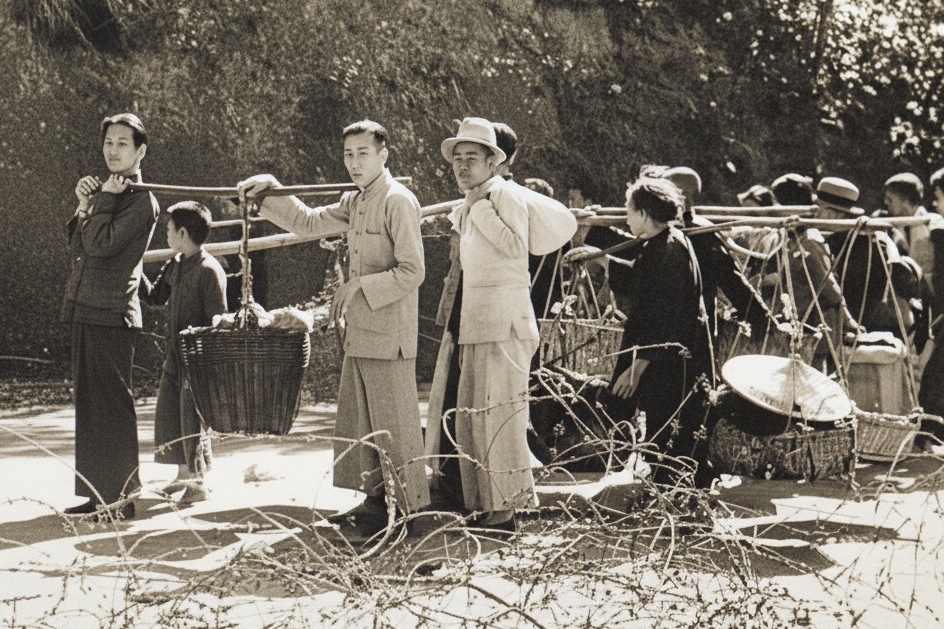
The exorbitant price was one problem, but another was that even if people were willing to pay, they could not necessarily obtain rice, as food shortages had made it necessary to implement a rice rationing system. Locals were required to line up at rationing stations to buy rice with coupons. Initially, each person could purchase 6.4 taels of rice per day. As food became scarcer, the amount they could buy decreased even further, and a rice coupon was no guarantee of getting the rice they needed. That is where the local saying “lining up for rice” originated. In the latter stage of the World War, the food shortage in Hong Kong was so severe that countless people died from starvation or malnutrition, and newspapers even reported incidents of cannibalism. This breakdown of law and order deepened the local community’s resentment towards the Japanese invaders. To mitigate resistance and relieve pressure from food shortages, the Japanese military introduced a so-called “homeward bound” policy in 1942, forcing Hong Kong residents to relocate to Mainland China. With no transportation available, walking north was the only option for the majority. Burdened with aging parents and young children, many perished on the arduous journey.
Another effect of the military yen on the Hong Kong economy at the time manifested itself in trade. The fact that both the Hong Kong dollar and foreign exchange were illegalized from 1943 onwards while the military yen in Hong Kong could not circulate elsewhere created tremendous challenges to the city’s trade settlement, making it extremely difficult for the city to conduct trade with the outside world through legal channels. Resources could only come in and out of Hong Kong through the black market while goods could only be exchanged by barter. Hong Kong being a trading hub all along, trading contraction inevitably spurred economic contraction for the city.
Banknotes are rightfully considered an asset to the holders and a liability to their issuers. By the same token, the military yen represented a debt owed by Japan to the people of Hong Kong. However, since the so-called “cessation of war” on 15 August 1945, the Japanese government has neither exchanged nor compensated for the military yen issued in Hong Kong. Hence a large quantity of the military yen was reduced to worthless paper overnight, causing those who held military yen out of fear of holding Hong Kong dollars to instantly lose all their assets. Over the years, many victims have sought compensation and some even appealed in person to the Tokyo District Court and High Court, but all to no avail. The Japanese government’s stance on the military yen mirrors its position on the invasion of China and other Asian nations: a brazen sense of entitlement to wanton plunder, coupled with and a lofty yet irresponsible and evasive attitude. Yet we will never forget.