
By Prof Joseph Chan, HKU Business School, Associate Director at Centre for Innovation and Entrepreneurship
AGI (Artificial General Intelligence) is the AI that could learn, decide and execute, and we are already in its early days. Just this week, Meta has rolled out its agent Muse, and quite a few service-based digital platforms have seen their stock price drop in the US stock market. Its related conversation has shifted from “what if” to “how fast,” and the answer is unsettling. We see glimpses of AI agents communicating with other AI agents, creating an acceleration loop in tech innovation that has never happened before. As such, while most business still runs on our familiar B2B or B2C business models, the groundwork for an agent-to-agent world has already been laid – a super-efficient flow without humans involved until the final sign-off. Some AI experts and developers who helped build this technology have voiced concerns, even raising the question of risk and fear to human existence. The ground beneath our work and lives might have started cracking – AI is having real impact, both positive and negative, from industries to individual job security.
On the positive side, companies embracing AI into their operations report gains in higher productivity and efficiency, and in niche industries such as the medical sector, scientific breakthroughs have been made. AI is helping design new drugs, target stubborn diseases, and solve math problems once thought impossible. For most businesses, AI is becoming not just a choice but a necessity. In education, new AI courses are everywhere; yet with new developments appearing around every corner, how much of what is taught today will still be valid tomorrow? The shelf-life of ‘up to date’ AI knowledge is shrinking fast.
For individuals and their job, concerns have been voiced. As companies are streamlining operations with AI, they need fewer people. The heaviest early impact falls on junior positions and repetitive, digitally heavy jobs. This trend is likely to speed up. Yet there is the positive side – for those who learn to use these tools creatively, great opportunities are emerging, creating new value, opening entirely new career paths.
This article is a survival guide for all of us in this post-AI era — whether you are navigating your career or steering an organization. The rules are being rewritten by the widespread use of AI and AGI. It is whether you will write your own chapter or be written off.
Individual Planning Roadmap – One’s Value is measured by the ability to Create Value
The first principle is to stay positive and face the change head-on. This is a conscious decision to be mentally ready. Those who thrive are not necessarily the most technically gifted, but the ones who look at disruption and ask, “How should I work with it?”. ‘Value’ is the keyword at the heart of the strategy. Your worth is now measured by your ability to create value, which likely also involves AI application. It is in understanding the company’s vision and the brand’s soul, knowing how to truly connect on a human level, and making qualitative judgments on top of quantitative algorithms, like curator, director or executive decision-maker. Your job is to investigate deeper context and emotional intuition, in a professional and ethical human way.
The second principle is to learn, at least aware of, the latest technological trends; and the best way to learn is through experimentation and learning by doing. You may test how AI may improve your workflow while also testing its limits. This hands-on approach may make some feel uncomfortable, especially those less keen on change; however, good AI planning would help address that. Indeed, it is important for all to be able to carry out good and well-thought planning, which on one hand gives users the confidence in applying AI in the workflow, on the other hand it forms the essential part for project management and innovation management, including but not limited to efficient computing power, AI credit and token usage, as well as consistent quality output. It is a bridge connecting human management and AI exploration for those who prefer structure over improvisation.
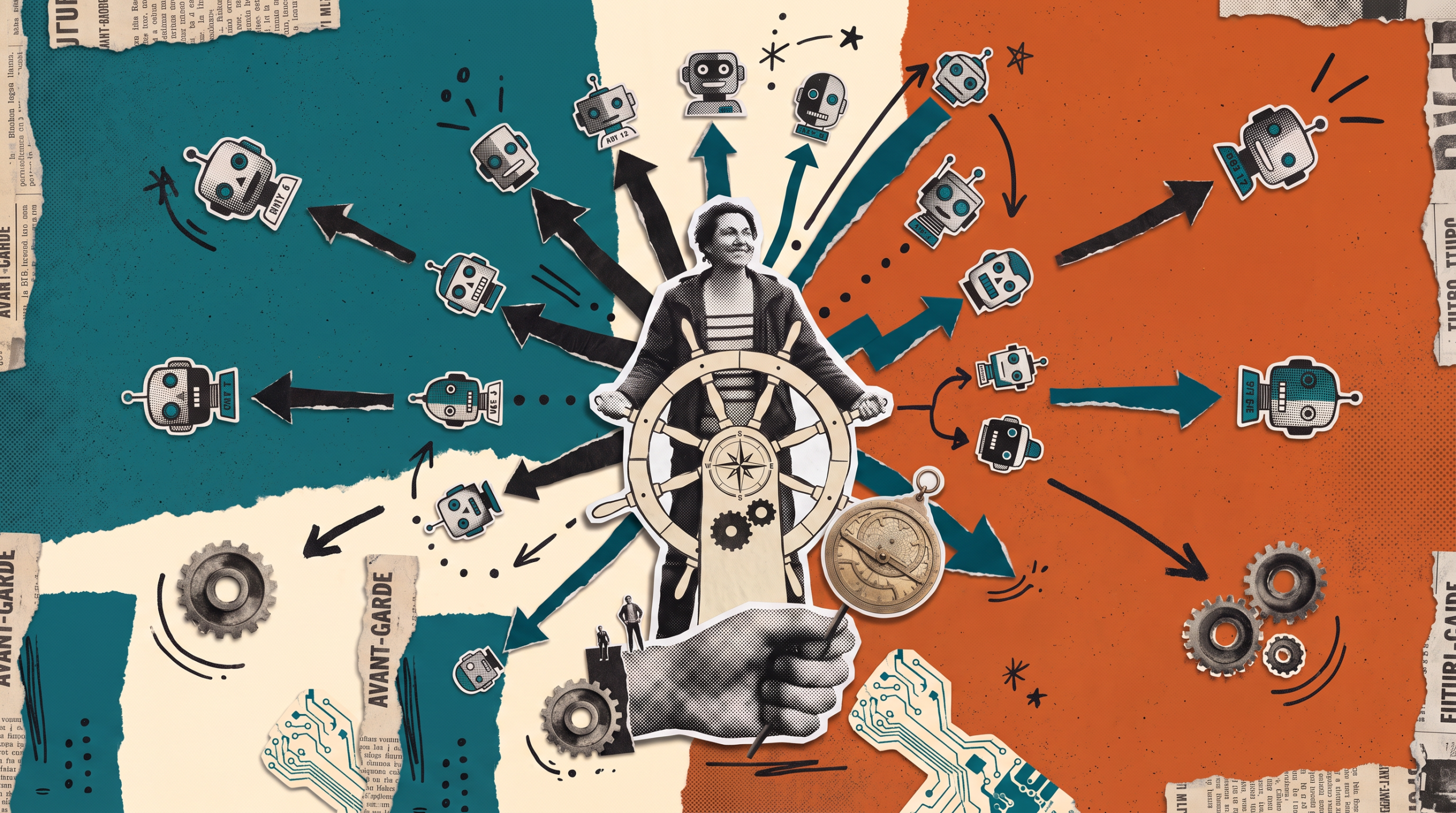
As for AI agent application, using it smartly, it could become a subordinate handling repetitive task, cross-disciplinary specialist multi-agent team members tackling complicated projects, or even a Nobel-prize-winning thought level partner co-developing your ideas against a vast backdrop of knowledge. If passively, you may be forced to react to someone else’s plan and may not have enough time to adapt. Therefore, a positive move is to start exploring now. The goal is not to outrun machines, but to become the human who confidently commands a fleet of them.
Corporate Strategy – A Transformative Steering
For companies, integrating AI in business demands a deeper shift than simply software update, which means operations revamped. Conventional “Waterfall management” approach – leaders plan upfront, teams execute rigidly – is becoming a liability. When new AI model and multi-disciplinary application are coming to scene almost every month or even week, bringing together changes that may not be expected, rigid plans could become outdated overnight. “Agile management” method, with its short iterative sprints, constant feedback, and flexible planning, is becoming the sensible way to run an AI-powered organization. The company organizational structure should be as adaptable as the technology it uses.
At the heart of this agile way of operation and transformation is the clear and innovative brief, aiming at delivering the brand soul and corporate value. This innovative brief is to be developed through value-added leadership, who truly understands context, brand, ethical boundaries, and could see the potential. It is not ideal to put operation budget into a slot machine that burns expensive AI tokens in seconds, while uncertain on the output. A precise, thoughtful brief defines the goal, sets non-negotiable boundaries, captures the brand voice, and leaves room for AI exploration. It ensures stronger and more consistent output aligned with the smart strategy.
With this AI power comes a serious governance challenge. Companies fear teams running rogue with AI workflows without oversight, potentially leaking data or creating compliance nightmares. Then there is the adversarial AI. Security is no longer just about firewalls. It is about protecting systems from malicious AI agents that could deceive or poison the company in the digital system at machine speed. Thus, project planning is taking on a new meaning. It is now the design of a choreographed workflow between human and AI. There are three layers: first, stage-specific targets, where the vision is elaborated into clear briefs for each phase, with human as gatekeeper. Second, workflow orchestration, planning where AI acts independently and where human input and review couldn’t be replaced. Third, digital security by design, where data rules and validation are embedded into the project from the start, blending project management with cybersecurity. This aligns with the OPC principle – not necessarily a literal “One Person Company,” but for a minimal team to deliver results once done by much larger departments. It is a tiny, aligned human core empowered by well-managed teams of AI multi-agents. It is about redesigning work so small teams punch far above the convention weight.
We have not even touched on the next frontier: online-offline coordination. Super cloud intelligence meeting physical hardware – advanced robotics is catching up fast. When a next-generation cross-dimensional AI brain connects with a capable robot, sci-fi movie stories in the past are now reality in industries like manufacturing, logistics, etc. and our daily life. We are all characters in this journey of which the script is still being written. The key to a good ending lies in one principle: humans thoughtfully drive towards the transformed world with intelligent machines. Let us embrace this milestone moment and shape our future.